
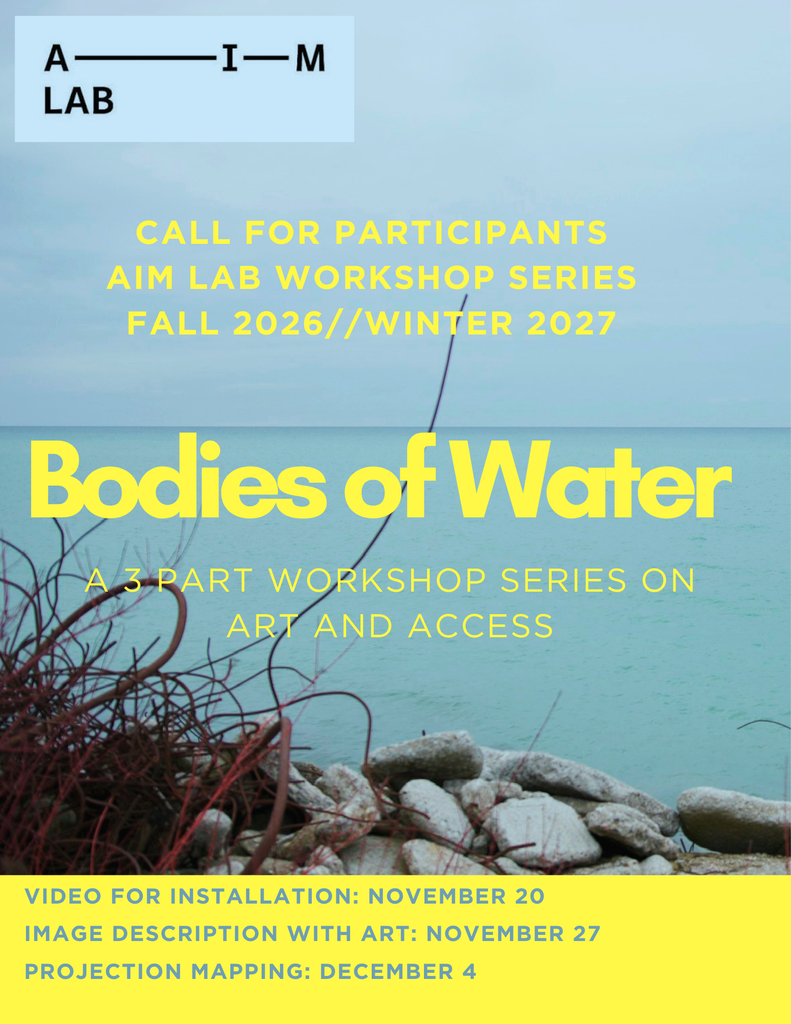
AIM Lab invites you to join our Fall/Winter workshop series. Building on our ongoing experiments in “access as research-creation”, our projects on disability and the Anthropocene, and our interventions in dominant modes of knowledge production, we invite participants interested in access, disability – both broadly understood – and institutional critique across a range of practices. Our workshops will be composed of two series.
The first one, on the theme of water, will focus on making videos for installation, and how access can shape media-making from its outset. Through three connected sessions, our lab member-facilitators will share hands-on skills for producing videos for installation, creating image descriptions for them, and exhibiting them at the AIM Lab space with attention to its design history and ethos.
Our second series situates access in the realm of knowledge production: what kinds of knowledge are put in areas of easy access and high circulation within the academia of the imperial core, and what others are pushed to its peripheries and exteriors? Through two sessions focused on anti-imperialist citational politics and syllabus-building, this series will offer tools for critical self-reflection on what/whom we cite, how we cite, and what impact our citations and syllabi have in the world.
Workshops are open to public and AIM membership is not required. Space is limited. Please fill in the registration form.
Workshop Series I: Bodies of water
Anchored in the theme of water, this workshop series explores the stories we have about water and how they shape the landscape. Water is never just a thing: it carries histories, and spiritual, political, bodily, and personal meanings. How do these stories co-exist? Which become dominant and get to define reality? Which are pushed aside or erased, and can they return through art and activism?
Emerging from AIM Lab’s Disability and the Anthropocene working group (2022-2026) discussing water and access, we will think about water through disability and the body: water as comfort, care, pain, and permeability. Swimming can soothe a body in pain; warm water can comfort sore hands while washing dishes. But what happens when we can’t access the water? Water is highly controlled, including literal control of access: states restricting shorelines and closing public spaces, bodies of water made unsafe (or illegal) to swim in through pollution, privatisation, and other means. Waterways carry traces of colonization, war, pain, and structural violences. What relationships can still be made through memory, images, sound, and the stories we share?
What will we do
Building on AIM’s past work, such as Ecologies of Access, and AIR RIVER SEA SOIL, this series considers access as research-creation through the production and realization of a multi-media video installation. We will look at how attending to access can reshape our material practices, sharing tools and techniques for thinking critically about access as a core aesthetic component of the artwork. The first session introduces techniques of video installation to explore the different meanings water holds. In the second session, we will learn about the world of image description and practice describing, using the videos created in session one. In the final session, we will experiment with video installation techniques through projection mapping. This series will culminate in a pop-up exhibition/ installation in the AIM Lab, where participants will get to know AIM Lab’s accessible space and be encouraged to respond to its design elements. In doing so, we will consider access at many stages of the production process: ideation, creation, post-production, and installation.
While these sessions are connected, participation in all three is not required. All three sessions will take place at the AIM Lab. Hybrid participation can be provided on demand.
Session 1: Producing Video for Installation
This session is an introduction to filmmaking for installation, focusing on simple techniques and equipment. Starting with a demonstration of filmmaking with iPhones and Camcorders, participants will learn technical basics for creating video with installation in mind. Participants will learn about lighting, how to create viewfinders and then have the opportunity to create footage. The workshop will end with a discussion of our footage and a chance to experiment with projection techniques.
Time and date: November 20, 12.00
Facilitated by: Rachel Rozanski
Time: 2 hours
Max Participants: 12
Session 2: Creating Image Descriptions
The goal of this workshop is to introduce participants to the vast world of Image Descriptions (ID). Taking cues from our Audio Description in the Making workshop with Cheryl Green and Thomas Reid, our Collective Image Description Methodology, and the personal experiences of AIM members, we will introduce some techniques and ideas on how to approach ID as part of the artistic process. Attendees are invited to use the videos created in session 1 or bring artworks and WIPs they would like to describe.
Time and date: November 27, 12.00
Facilitated by: Jessie Stainton, Rachel Rozanski, Mick Hennessy
Time: 2 hours
Max Participants: 12
Session 3: Projection Mapping
This session introduces projection mapping for site-specific art installation. Working from ideation to execution, participants will learn technical basics for projector installation, video compatibility and the software MadMapper. With the AIM Lab as our venue, participants will be briefly introduced to its design history, and ethos, and then create pop-up installations in the space by critically reflecting on how space design and architecture can shape the experience. Participants are invited to bring video footage related to the theme of water to project, or use footage from our video bank created in session one.
Time and date: December 4th, 12.00
Time: 3 hours
Facilitated by: Jessie Stainton, Rachel Rozanski, Mick Hennessy
Max Participants: 12 (working in groups of 3 or 4)
Workshop Series II: Citational politics
Details to be announced in January 2027 (stay tuned!)
Facilitator: Arseli Dokumaci
………………………………………………………………………………………..
Facilitation Team
Rachel Rozanski is an AIM Lab core member, filmmaker and artist, and a PhD student in Concordia’s Humanities program.
Jessie Stainton is an AIM Lab core member, an artist, and a PhD candidate in Concordia’s Communication Studies program.
Mick Hennessy is AIM Lab’s coordinator and a MA student in Concordia’s Translation Studies program.
Arseli Dokumaci is AIM Lab’s director, and Canada Research Chair in Critical Disability Studies and Media Technologies.